Choosing Alternative Education From the Beginning
Homeschooling wasn’t a sudden decision for us. And it certainly wasn’t a reaction to a single event.
From the very beginning, we knew we would pursue alternative education for our children. Traditional public school was never our plan. We believed strongly in parental involvement, values-based education, and smaller learning environments, and we were committed to choosing either charter or private school options that aligned more closely with our family’s priorities.
When COVID Changed Everything for Pre-K Families
When our boys were entering Pre-K, COVID hit — and overnight, everything changed.
Private Pre-K programs filled up almost instantly because they remained open, while public Pre-K options quickly became non-starters for us. What I witnessed during that time was deeply concerning. Toddlers — literal toddlers — were being penalized, disciplined, and even expelled for not wearing masks “properly.” And I remember thinking… if my high school veterinary science students — educated, trained, and repeatedly coached — struggled to comply consistently, how in the world were three- and four-year-olds expected to do this perfectly?
I had already left teaching 6 or 7 years earlier because of behaviors I was seeing in classrooms and the growing dysfunction within the system. I didn’t want to be another cog in a wheel that was clearly broken. And I absolutely did not want my children’s educational journey to begin with disciplinary records for simply being toddlers.
Why Private and Public Schools Still Weren’t the Answer
So we did what we could.
We found private programs. We enrolled our boys in schools we believed would offer structure, safety, and values. And for a time, it worked.
Until it didn’t.
One of our sons needed more support that private schools couldn’t help with. So we then tried our highly rated local elementary school — hoping the performance ratings and reputation would mean a rigorous education but while supporting our student’s needs.
What we found instead was bullying that went unchecked, inappropriate behaviors that were excused, and a system that often protected the violators while the victims were punished for reacting. After 2 years of rather violent bullying, and no help or real solution from the school staff or administration (despite being on campus literally all the time to volunteer my time and and to help raise funds for the school), at the height of what was becoming clear was a very heavy mental load for our other son… a teacher who wasn’t even his told him, at the tender age of 7 while taking a test in her room, that his own teacher didn’t want him. It broke him. Not only did the students constantly physically and verbally attack him, the adults wouldn’t protect him and some of them bullied him themselves.
So we left.
In that time, a private Christian school opened in our neighborhood. They came with a promise of a zero tolerance for bad behavior and (for a several hundred dollar fee) IEP support. So we enrolled. We paid large sums of money. And we prayed and started the year with a hopeful outlook that this environment would be like the 1st private Christian school we attended, which unfortunately couldn’t help our son with the IEP. But we had loved that experience and the community shared core values could provide. So we were willing to try again with tall promises from their Administration.
Unfortunately, the behaviors we had been trying to avoid began showing up there, too. Disruption. Disrespect. Lack of accountability. And it was worse than the public school. Multiple students. Multiple threats and fights. Multiple incidents.
That Fall we were called into speak with the school Principal. We walked in thinking our students were in trouble for defending themselves… yet again. The previous week I had been called to come pick up one of my students because he had gotten in the face of one of his bullies and was extremely agitated and could not be calmed down. He had not laid a hand on the other student or vice versa (this time, anyway). But something was off. On the way home, he calmed down in the car enough to explain to me that he had lost his cool when his usual bully had turned his attention on a girl with Down Syndrome in their PE Class and was making fun of her and no one stepped up to stop it or defend her. He had been caught yelling at the bully – defending another student with special needs. And for that he was punished. So we walked into this meeting expecting this would be the topic at hand.
But we were blindsided when we sat down to talk.
Through literal tears, our children’s Principal explained that their teacher had been targeting them verbally in the classroom and encouraging other students to harass them in an effort to detract from her own shortcomings as a teacher. She had not been teaching math or science all semester. She had not been individualizing instruction as she was hired to do. And her classroom culture was toxic.
We were absolutely dumbfounded.
We received an apology from the Principal that it had taken him so long to figure out what was going on. We were assured that she was going to be replaced, and that certain students were going to be asked to leave.
We started the new semester with high hopes.
Yes, many students left over the winter break. But a few, some of the worst, remained.
Being a former teacher, I knew how hard managing multiple behaviors could be. I was also well acquainted with taking over a new program and knew what it was like to step into a classroom where students felt an affinity for the previous teacher and the need to “test” you. So I volunteered to be in the classroom all day, every day to help support the new teacher and to monitor my own kids.
It was not long after the return from Christmas break that we started noticing something was very wrong. I witnessed some of the worst, most disruptive beahvior I had ever seen in my life. Yes, including over 20 yrs in classrooms in inner city schools, some of Arizona’s poorest schools, classes where 60% of the students would suffer from things like Fetal Alcohol Syndrome, severe ADHD, and a litany of other diabilities. I had taught gang members, kids from cartel families, and kids with ankle bracelets. Yet my experience in some of Arizona’s most challenging schools and classrooms paled in comparison to how I was seeing young, bright, afluent, and otherwise perfectly mentally and physically able-bodied and able-minded children behave. I was floored.
The worst part? They were allowed to bully others. Openly. Unapologetically. And it was swept aside as “typical age appropriate behavior”.
That was a breaking point.
By Spring Break, we were completely exhausted as a family, stressed out, and over stimulated. And it was clear the school wasn’t thrilled about continually being asked to deal with the amount of problems happening regularly on their campus.
We were doing everything “right.” We were choosing alternative education. We were being involved parents. We were advocating. We were staying engaged. Supporting the teacher. Buying supplies for classrooms. And yet… the same problems kept finding us.
And that’s when the conversations changed.
Not if we could homeschool.
But whether we should.
The RV Life We Lost When School Took Over
At the same time, something else was happening in the background.
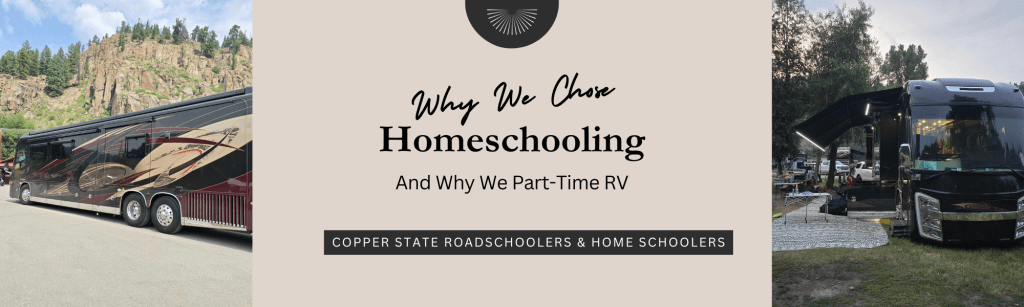
My husband grew up RVing. Truly RVing. He was gone nearly every weekend on another adventure with his parents — traveling, exploring, learning on the road. It was normal for him. It shaped him. And he remembers it fondly.
Before we had kids, we were the same way. We could pick up and go whenever we wanted. Weekend trips. Long weekends. Last-minute adventures. Life was flexible.
Once the kids entered school, that freedom slowly disappeared.
Suddenly, everything had to fit into tiny calendar windows. Travel was crammed into short breaks. Weekends were rushed. And our motorhome… just sat. In the driveway. Barely used.
And if you know anything about motorhomes, you know this: they are not meant to sit. Rubber seals dry out. Tires crack. Water stagnates. Engines and generators go unused. Things break.
Motorhomes are meant to move.
And ours wasn’t.
We found ourselves working harder and harder to “fit life in” around school schedules, while the very thing we had invested in to create memories and experiences for our kids sat unused. It felt backwards.
Wanting More Than Just an Education for Our Boys
At the same time, we were having more and more conversations about the boys — their potential, their curiosity, their questions, and their hearts. They are bright. Both are blessed to be incredibly gifted academically. They are thoughtful. They absolutely LOVED history, reading, and learning. They are sensitive. And they are watching everything. Including how we respond to abuse.
We realized we didn’t just want them educated.
We wanted them grounded.
We wanted them safe.
We wanted them confident.
We wanted them to know who they are, what they believe, and why.
And we wanted to be present for that.
Not just in the evenings. Not just on weekends. Not in a classroom surrounded by chaos and behavioral issues that seemed like we were solely present to manage the poor parenting of others.
We wanted to be present in the learning. In the questions. In the growth. In a calm environment where picking fights or degrading others wasn’t considered “normal”. Where they could work ahead if they wanted (which they often tried to do).
Before I became a Realtor over a decade ago — and long before I became a mom — I was a high school Agriculture teacher. And before that, I had interned at the AZ Department of Education and had spent quite a lot of time traveling the state and seeing the good, the bad, and the ugly. Lesson planning, curriculum structure, and educational pacing were not foreign to me. That gave me confidence that if we chose this path, I wasn’t walking into it blindly.
The Conversation That Changed Everything
Still, it was a big decision.
We talked. We prayed. We debated. We questioned ourselves. We wondered if we were being unrealistic. We wondered if we were being too idealistic.
And then on our long spring break drive to California, the conversation shifted.
We weren’t just talking about whether we could homeschool.
We were talking about whether we should.
We talked about the behaviors we were seeing.
We talked about the influences we couldn’t control.
We talked about the limited time we had with our kids.
We talked about the motorhome sitting unused.
We talked about the life we used to live — and the life we wanted again.
“Can We Have Art Class at the Washington Monument?”
And then, from the back seat, one of our twin boys asked a simple question:
“Can we have art class at the Washington Monument in DC and learn to paint it?”
It stopped us.
Not because it was impractical.
Not because it was unrealistic.
But because it was… possible.
That was the moment it clicked.
Not just that homeschooling could work.
Not just that roadschooling was an option.
But that this was the life we actually wanted to live.
A life where learning didn’t have to be confined to a classroom.
Where history wasn’t just read about — it was seen.
Where art didn’t have to happen at a desk — it could happen in front of a monument.
Where education could be woven into travel, experience, and curiosity.
That single question reframed everything.
Why We Ultimately Chose Homeschooling and Roadschooling
And slowly, without a big dramatic announcement, we realized we were all thinking the same thing.
This wasn’t about school.
This was about family.
This was about freedom.
This was about intentional living.
This was about raising our boys, not outsourcing them.
So we made the decision.
Not to run away from anything.
But to run toward something better.
Toward a life where learning could happen at the kitchen table, in museums, at historical sites, in state capitols, on back roads, and in national parks.
Toward a life where travel wasn’t an occasional reward, but part of how we lived and learned.
Toward a life where our boys could grow up seeing the country, understanding history, and experiencing the world firsthand.
From Decision to Action
Looking back, the shift didn’t happen all at once — it was a series of conversations, observations, and quiet realizations that kept pointing us in the same direction: our family needed more margin, more freedom, and more intentional time together. We didn’t just want to “get through” school — we wanted to build a life where learning could happen in the real world, where our boys could grow in character, curiosity, and confidence.
And then came the moment we stopped talking about it… and actually did it.
If you want to see what our very first official day of homeschooling looked like — how I pulled lessons together, what we did, and why our boys ended that day completely “all in” — head to the next post: First Day of Homeschooling: March 17, 2025
 Copper State Homeschoolers & Roadschoolers