What if one of the greatest experiments in self-government wasn’t built by graduates of a public school system—but by men whose earliest education took place around a family table, in a home library, or under the guidance of a private tutor?
As homeschool and roadschool families, we often hear the question: “But what about socialization?” or “Can kids really get a quality education at home?”
History has an interesting answer.
Many of the men who founded the United States never attended what we would recognize as a traditional school. Instead, they were educated primarily at home, by parents, private tutors, ministers, or through self-directed study. Some later apprenticed under lawyers, merchants, or scholars. A handful attended college, but even those institutions looked very different than today’s universities.
The education that shaped America’s founders was built on curiosity, discipline, reading, discussion, and real-world experience.
What Did “School” Look Like in Colonial America?
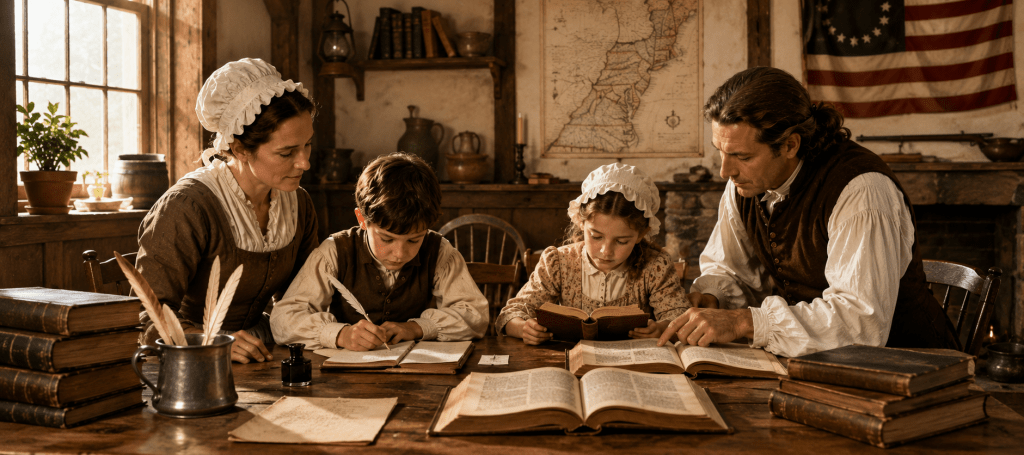
In the 1700s, there wasn’t a nationwide public school system.
Education depended largely on family circumstances.
Most children learned at home from parents or relatives. Wealthier families often hired tutors. Boys who planned to enter law, medicine, politics, or the ministry frequently apprenticed under an experienced professional rather than enrolling in a formal school.
Learning wasn’t divided into neat grade levels.
Instead, students advanced as they mastered subjects.
A typical education included:
- Reading and writing
- Arithmetic
- History
- Geography
- Bible study
- Latin and sometimes Greek
- Logic
- Rhetoric (persuasive speaking and writing)
- Classical literature
- Moral philosophy
- Practical skills for everyday life
Perhaps most importantly…
Students were expected to think.
They debated ideas.
They defended arguments.
They read difficult books.
They learned how to solve problems rather than simply memorize answers.

Founding Fathers Who Were Primarily Educated at Home
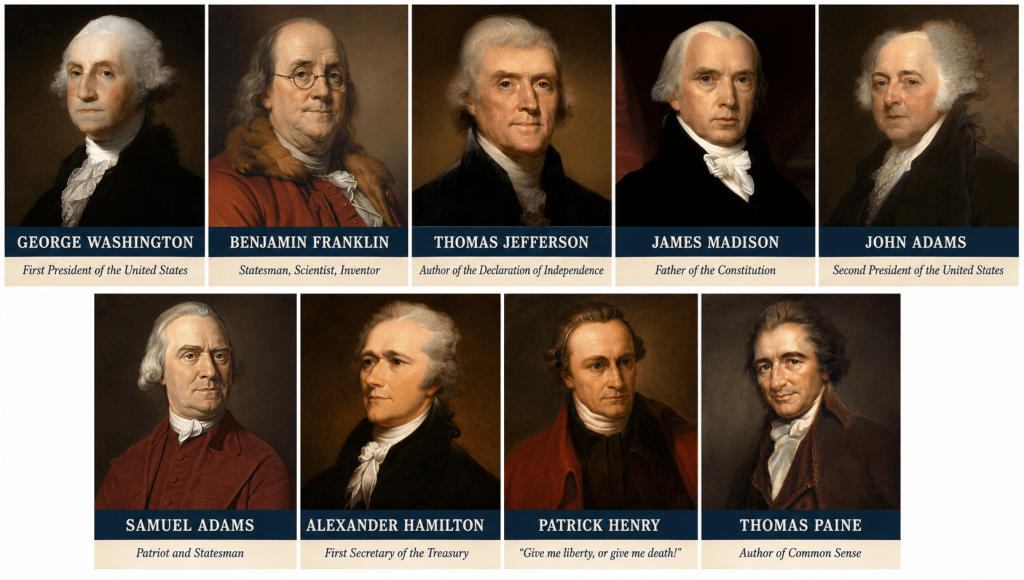
George Washington
George Washington never attended college.
His early education came almost entirely at home under the supervision of his father and older half-brother. After his father’s death, much of his learning became self-directed.
Instead of university, Washington pursued surveying as a teenager, learning mathematics, geometry, mapping, and practical engineering in the field.
Those skills would later prove invaluable during both the French and Indian War and the American Revolution.
Benjamin Franklin
Franklin attended formal school for only about two years.
His father could no longer afford tuition, so Benjamin continued learning at home before being apprenticed to his brother James, a printer.
From there, Franklin essentially educated himself.
He famously read everything he could find.
History.
Science.
Politics.
Philosophy.
Economics.
Languages.
His relentless curiosity eventually made him one of the greatest inventors, diplomats, scientists, and writers in American history.
Thomas Jefferson
Jefferson’s earliest education took place at home under tutors hired by his family.
He later attended preparatory schools before entering William & Mary.
His lifelong love of reading became legendary.
His personal library became so extensive that after the British burned Washington during the War of 1812, Jefferson sold thousands of his books to Congress, forming much of what became today’s Library of Congress.
James Madison
Madison was educated primarily at home by his mother and private tutors before attending boarding school and later Princeton.
His early education emphasized history, classical languages, philosophy, and theology.
Those studies helped prepare the man later called “The Father of the Constitution.”
John Adams
Adams learned much of his early education at home before attending local schools and eventually Harvard.
His parents emphasized reading, morality, discipline, and independent thinking long before college.
Samuel Adams
Samuel Adams likewise received much of his foundational education at home before later attending Boston Latin School and Harvard.
Alexander Hamilton
Hamilton’s story may be the most remarkable.
Born out of wedlock in the Caribbean, he received little consistent formal schooling.
Instead, he educated himself through reading while working as a clerk in a trading company.
His obvious intelligence impressed local businessmen, who funded his education in America.
He would later become George Washington’s trusted aide, co-author of the Federalist Papers, and America’s first Secretary of the Treasury.
Patrick Henry
Patrick Henry received much of his education from his father at home.
His father taught him mathematics, classical literature, and history.
Henry never attended law school.
He studied law independently and passed the bar examination after only several weeks of concentrated study.
Thomas Paine
Although not technically a Founding Father in the constitutional sense, Thomas Paine’s writings inspired the Revolution.
He received little formal education beyond childhood.
Much of his learning came through self-study and practical work experience before writing Common Sense, one of the most influential political pamphlets ever published.
Not Every Founder Followed the Same Path
Some founders did attend college.
John Hancock attended Harvard.
James Wilson studied at the University of St. Andrews in Scotland.
John Jay attended King’s College (now Columbia University).
John Witherspoon was both a university graduate and later president of Princeton.
Yet even these men generally spent their earliest years learning at home before advancing into higher education.
College was typically reserved for advanced study—not elementary education.
The Common Thread Wasn’t School…
It Was Learning.
Whether home educated…
Tutored…
Apprenticed…
Or university trained…
America’s founders shared something far more important than where they learned.
They possessed an insatiable curiosity.
They read constantly.
They debated ideas.
They studied history.
They wrestled with difficult questions.
They understood that freedom required informed citizens.
Many spent years reading thinkers like Aristotle, Cicero, Locke, Montesquieu, Blackstone, and the Bible itself—not because someone assigned a worksheet, but because they genuinely wanted to understand how civilizations rise… and how they fall.
Why This Matters Today
Homeschooling isn’t about recreating a one-room schoolhouse.
It isn’t about proving one educational model is superior to another.
It’s about recognizing that education has never been confined to four walls.
Learning happens in libraries.
Museums.
Historic battlefields.
National parks.
Kitchen tables.
On road trips.
Around campfires.
At Mount Vernon.
In Philadelphia’s Independence Hall.
Standing beneath the Statue of Liberty.
Walking Valley Forge.
Watching the mist rise over Niagara Falls.
Or touring the United States Capitol where the principles our founders debated continue to shape our nation today.
History becomes unforgettable when children can stand where it happened.
Our Family’s America 250 Journey
As our family celebrates America 250, we’ve been blessed to visit many of the places where our nation’s story unfolded.
We’ve stood inside Independence Hall.
Walked the grounds of Valley Forge.
Visited George Washington’s Mount Vernon.
Toured the United States Capitol and the Pentagon.
Stood beneath the Statue of Liberty.
Looked across Niagara Falls.
And with every stop, we’ve been reminded that history isn’t just something to memorize…
It’s something to experience.
The men who founded this nation were lifelong learners. Their education didn’t end when they left home—or college. It continued through reading, observing, asking questions, and engaging with the world around them.
That’s the heart of home schooling… and road schooling.
Not simply covering curriculum… But raising children who are curious enough to ask questions, confident enough to seek answers, and wise enough to learn from the generations who came before them.
As America celebrates her 250th birthday, perhaps there’s no better lesson we can teach than this:
A free nation depends upon a people who never stop learning.
America 250 Roadschool Challenge
Over the next year, choose one Founding Father to study as a family. Read one biography, visit one historic site connected to his life, and read at least one of his original writings. By America’s next birthday, you’ll have a deeper appreciation for the people—and the ideas—that helped shape our nation.
Continue Your Journey Through America’s Founding
If this article sparked your curiosity, you’re not alone. One of the things that made America’s Founding Fathers extraordinary wasn’t simply where they learned—it was their lifelong pursuit of knowledge. They were voracious readers, deep thinkers, and students of history who never stopped learning.
Below are some of the best biographies and primary sources available if you’d like to dive deeper into the lives and writings of the men who helped establish the United States.
Disclosure: Some of the links below may be affiliate links. If you choose to purchase through them, it helps support Copper State Road Schoolers at no additional cost to you. Thank you!
George Washington
Recommended Biography
Washington: A Life by Ron Chernow (Available on Amazon).
Widely considered the definitive modern biography of George Washington, this Pulitzer Prize-winning work explores Washington’s leadership, military service, character, and the challenges of becoming America’s first President.
Primary Sources
- The Diaries of George Washington: (Available as hardcover or paperback on Amazon or free digitally through National Archives.
- The Writings of George Washington: (Available in multiple formats on Amazon or digitally through National Archives.
- George Washington’s papers on the National Archives Founders Online:
https://founders.archives.gov/
Benjamin Franklin
Recommended Biography
Benjamin Franklin: An American Life by Walter Isaacson (Available on Amazon).
An engaging biography that follows Franklin from curious apprentice printer to scientist, inventor, diplomat, and Founding Father.
Primary Sources
- The Autobiography of Benjamin Franklin (Available in multiple formats on Amazon).
- Poor Richard’s Almanack (Multiple formats on Amazon).
- Franklin Papers:
https://founders.archives.gov/
Thomas Jefferson
Recommended Biography
Thomas Jefferson: The Art of Power by Jon Meacham (Available in multiple formats on Amazon).
This book is known as one of the most balanced modern biographies of Jefferson, examining both his brilliance and complexities.
Primary Sources
(Links to Amazon for hard copy, physical copies, and Kindle versions as well as link to National Archives for free digital copies.)
James Madison
Recommended Biography
James Madison by Richard Brookhiser
A concise but excellent biography of the man often called “The Father of the Constitution.”
Primary Sources
- The Federalist Papers (especially Madison’s essays)
- Madison Papers:
https://founders.archives.gov/
John Adams
Recommended Biography
John Adams by David McCullough
One of the finest presidential biographies ever written, and the inspiration behind HBO’s acclaimed miniseries.
Primary Sources
- The Adams-Jefferson Letters
- Adams Papers:
https://founders.archives.gov/
Samuel Adams
Recommended Biography
Samuel Adams: A Life by Ira Stoll
An outstanding look at one of the Revolution’s most influential yet often overlooked leaders.
Primary Sources
- Samuel Adams writings available through the Massachusetts Historical Society.
- Revolutionary correspondence and speeches available through the Library of Congress.
Alexander Hamilton
Recommended Biography
Alexander Hamilton by Ron Chernow
The Pulitzer Prize-winning biography that inspired the Broadway musical, offering a far more detailed and historically rich account of Hamilton’s remarkable life.
Primary Sources
- The Federalist Papers
- Hamilton Papers:
https://founders.archives.gov/
Patrick Henry
Recommended Biography
Patrick Henry: First Among Patriots by Thomas S. Kidd
Perhaps the best modern biography of America’s fiery orator and defender of liberty.
Primary Sources
- Patrick Henry speeches
- Patrick Henry correspondence
- Available through the Library of Congress and various university archives.
Thomas Paine
Recommended Biography
Thomas Paine by Craig Nelson
A compelling biography of the man whose writings helped ignite the American Revolution.
Primary Sources
- Common Sense
- The American Crisis
- Rights of Man
All three are freely available in the public domain through Project Gutenberg and other online archives.
Every American Should Read These
If you only have time for a few books, I’d recommend starting with these classics:
- Washington — Ron Chernow
- John Adams — David McCullough
- Benjamin Franklin: An American Life — Walter Isaacson
- Alexander Hamilton — Ron Chernow
- Thomas Jefferson: The Art of Power — Jon Meacham
Read What They Read
One of the most fascinating ways to understand the Founding Fathers is to read the books and thinkers that shaped their thinking. Many of these works are freely available online.
Recommended reading includes:
- The Holy Bible (especially the King James Version commonly used during the colonial era)
- John Locke – Two Treatises of Government
- Montesquieu – The Spirit of Laws
- William Blackstone – Commentaries on the Laws of England
- Plutarch – Lives
- Cicero – On Duties and selected orations
- Aristotle – Politics
- The Federalist Papers
- The Anti-Federalist Papers
- The Declaration of Independence
- The U.S. Constitution
- The Bill of Rights
How are you celebrating America 250 with your family? We’d love to hear about your favorite historic destinations, museums, or roadschool adventures. Join the conversation with Copper State Road Schoolers as we continue exploring America’s story—one mile, one monument, and one lesson at a time.
Sources Used in Writing This Article
The information in this article was compiled from primary historical documents and respected historical scholarship, including:
- National Archives – Founders Online (https://founders.archives.gov/)
- Library of Congress
- George Washington’s Papers
- The Papers of Thomas Jefferson
- The Papers of James Madison
- The Adams Papers
- Benjamin Franklin Papers
- The Massachusetts Historical Society
- The Library of William & Mary
- Mount Vernon Digital Encyclopedia
- Monticello Digital Research Collections
- Colonial Williamsburg Foundation
- Ron Chernow, Washington
- Ron Chernow, Alexander Hamilton
- David McCullough, John Adams
- Walter Isaacson, Benjamin Franklin: An American Life
- Jon Meacham, Thomas Jefferson: The Art of Power
- Richard Brookhiser, James Madison
- Ira Stoll, Samuel Adams: A Life
- Thomas S. Kidd, Patrick Henry: First Among Patriots
- Craig Nelson, Thomas Paine

Affiliate Disclosure
Some of the links on this page are Amazon affiliate links. As an Amazon Associate, we earn a small commission from qualifying purchases—at no extra cost to you. Every purchase helps support Copper State Road Schoolers and allows us to continue creating free homeschool resources, roadschool lessons, family travel guides, and educational content. We truly appreciate your support!
 Copper State Homeschoolers & Roadschoolers